314 MWdc / 233 MWh
storage installed capacity

Kuy Creek Solar & Storage Project

Located in Goliad and Victoria Counties, Texas, the Kuy Creek Solar & Storage Project is a utility-scale clean energy development currently advancing through environmental studies, land agreements, and interconnection milestones. The project spans approximately 1500 acres and is expected to begin construction in 2027, with first power anticipated in 2029.

314 MWdc / 233 MWh
storage installed capacity

584 GWh / year
annual production capacity

1,500 acres
of land

~55,000 Homes
powered each year

330,000+
metric tons of carbon emissions saved

2029
expected grid connection

24/7 Monitoring
of the energy storage system allows for rapid response, if needed

Meets or exceeds national safety codes and standards
rigorous testing ensures the project also meets multiple international safety certifications

Safety is of the utmost priority
from advanced system design to third-party validation to site layout, safety is built into the project
“Kuy Creek Solar & Storage reflects EE North America’s commitment to delivering reliable, sustainable energy to Texas. By pairing solar generation with battery storage, this project will strengthen grid resilience, reduce carbon emissions, and support long-term economic development in Goliad and Victoria Counties.”EE North America
Environmental studies, land agreements, and interconnection progress
Development activities continue
Anticipated start of construction
Expected first power
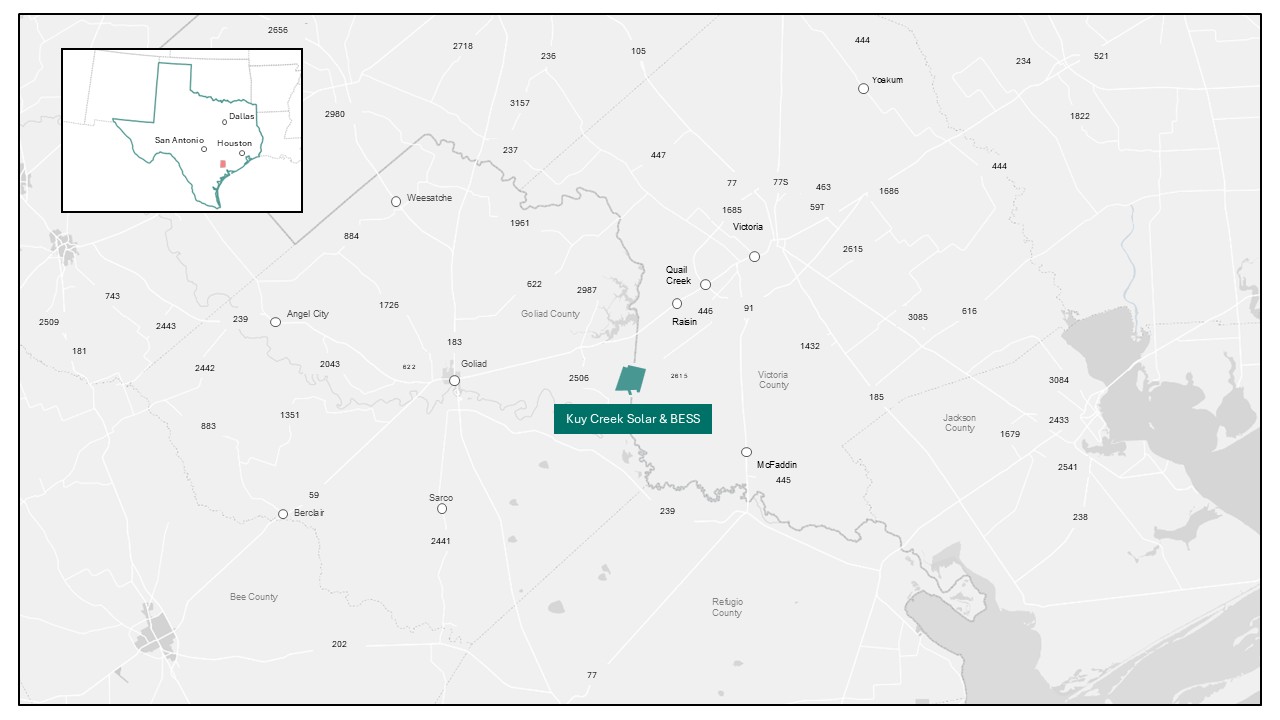
We selected this location based on a combination of factors including proximity to existing transmission infrastructure, solar resource quality, land availability and interest from landowners. Additionally, we conducted detailed environmental, cultural, and community assessments to ensure the site is suitable for long-term clean energy development.
Utility-scale solar refers to large solar power plants that generate electricity for the power grid, providing clean and renewable energy to homes, businesses, and industries. These power plants use solar photovoltaic (PV) panels to convert sunlight into electricity, which is then transmitted to the grid.
A utility-scale energy storage system is a facility designed to store electricity for use when demand is high. These systems improve grid stability, enhance reliability, and support the integration of renewable energy sources by storing excess electricity and delivering it when needed.
Utility-scale solar projects consist of rows of solar panels mounted on the ground, typically in areas with high solar exposure. These projects may also include tracking systems that allow the panels to follow the sun’s movement, maximizing energy generation throughout the day. Utility-scale energy storage projects typically consist of battery units housed in protective enclosures, similar in appearance to shipping containers, strategically placed near solar installations or grid infrastructure.
Solar energy complements conventional energy sources by supplying power during peak demand periods, such as hot summer afternoons when electricity use is high. When paired with energy storage, solar farms can provide reliable electricity even when the sun isn’t shining. Energy storage helps stabilize electricity prices by mitigating the variability in power supply and demand, reducing reliance on expensive peak-hour power generation.
Utility-scale solar and energy storage projects improve grid resilience, reduce power outages, and enhance the efficiency of renewable energy integration. These projects also generate tax revenue for local governments, funding infrastructure improvements and public services, and create jobs during construction and operation.
The project brings direct benefits to the community through tax revenue that supports local schools and services, job creation during construction and operation, lease payments to participating landowners, and potential partnerships with local educational and conservation initiatives.
The project will provide to support local services, schools, and infrastructure. This funding helps improve community resources and may reduce the tax burden on residents over time.
Studies across the U.S. show that utility-scale solar and energy storage projects do not negatively affect local property values. These projects are typically designed with visual screening and operate quietly, ensuring minimal impact on neighboring properties. In some cases, nearby properties have even seen value appreciation due to increased infrastructure investment in the area.
Electricity generated by the project will first serve the local area through nearby transmission and distribution lines. Depending on grid needs, some energy may be routed to larger cities, but priority will be given to nearby communities and infrastructure.
No. The project is funded by private investment, including loans, equity, and federal tax incentives common across all energy sectors, including oil, gas, nuclear, wind, and solar. Local taxes from the project will be paid directly to Goliad and Victoria Counties and local entities.
A vegetative screening plan incorporating native trees and shrubs will be implemented to blend the project into the landscape. This ensures minimal visual impact while enhancing local native biodiversity.
No. The solar panels we use are designed with anti-reflective coating to absorb sunlight rather than reflect it. We also conducted glint and glare studies to ensure there is no impact on roadways and nearby residences.
The solar panels are mounted in rows, approximately 9–10 feet high, and will be surrounded by fencing and vegetation. We are working to preserve as much of the natural vegetation as possible and will use additional vegetative screening if needed to reduce visual impacts.
There will be minimal lighting at the project site and only for safety and security purposes. Any lights installed will be downward-facing and motion-activated. The facility is not staffed full-time and does not require overhead or street lighting.
The land underneath and surrounding the solar panels will be maintained using best practices such as native grass seeding and rotational mowing. We are exploring options for habitat restoration and pollinator-friendly ground cover to support biodiversity.
At the end of the project’s life, we are committed to fully decommissioning the site. This includes removing all equipment, restoring the land, and recycling components where possible. Our land lease agreements and decommissioning plans ensure this commitment is upheld.
The project includes comprehensive wildlife protection measures such as establishing buffer zones around sensitive areas, adjusting construction timelines to avoid critical seasons, and preserving existing habitat. These steps follow environmental best practices and regulatory guidelines, ensuring we minimize disruption and support biodiversity throughout the project’s lifecycle.
Texas’s energy landscape is evolving rapidly, and utility-scale solar and storage projects are a key part of meeting growing electricity demand cleanly and reliably. Our project helps reduce the need for carbon-intensive peaker plants that run during high-demand periods, while the battery storage component supports grid stability across the broader ERCOT system. The net impact of this project, measured in emissions avoided, grid reliability gained, and land managed responsibly, reflects our commitment to development that benefits both the community and the environment.
While any development has a footprint, this project is designed to minimize it through responsible land management, wildlife protection measures, and a full decommissioning plan at the end of the project’s life.
The project prioritizes water resource protection by avoiding jurisdictional waterways, implementing erosion control measures, and ensuring sustainable land management practices.
Modern crystalline silicon (c-Si) solar panels are consistently characterized as non-hazardous under the EPA’s testing procedure, which tests for leaching of toxic chemicals under conditions far more extreme than real-world field conditions. Even in these extreme conditions, modern c-Si solar panels do not present a risk of leaching toxic chemicals or PFAS.[1] Testing consistently finds that leachate concentrations are far below the EPA’s allowable thresholds.
Less than a third of the project footprint will be occupied by solar panels, batteries, and other equipment. The solar panel area will have open spaces for native grasses and pollinator habitat and clearances for operations and maintenance. The battery area will be less than two acres, including open space for safety and service access. Final acreage figures will be posted when available.
Yes, for safety and security reasons, the project will be enclosed with a fence. We are planning to use a fence that is non-obtrusive and blends in with the rural character of the area. The design will prioritize minimizing visual impact for neighbors.
The project will generate some minimal noise during construction, including typical construction activity and vehicles. Once operational, any sound from inverters and transformers is low-level and not typically audible from nearby homes or roads.
A detailed visual assessment has been conducted to ensure that the project remains unobtrusive. Landscaping measures and careful site design further minimize visibility from surrounding communities.
Yes. EE North America is responsible for maintaining the project throughout its lifespan, including vegetation management, keeping the fence in good condition, and ensuring that the site remains clean and safe.
The project is still in development, and final site design elements are being evaluated. Once plans are finalized and ready to be shared publicly, we will make appropriate documents available through public channels and forums.
The Kuy Creek Solar & Storage project prioritizes fire safety through a comprehensive, multi-layered fire prevention and emergency response plan. This includes:
Yes, significantly. The Kuy Creek project will use Lithium Iron Phosphate (LFP) batteries, a chemistry selected specifically for its thermal stability. LFP batteries contain no cobalt or nickel, and the strong chemical bonds in their cathode material make thermal runaway significantly harder to trigger than in earlier lithium-ion chemistries.
The broader industry data reflects this trajectory. According to the Electric Power Research Institute (EPRI), the most authoritative independent research body tracking BESS incidents globally, found that the battery storage failure rate dropped 98% from 2018 to 2024, even as total installed capacity increased approximately 3,000% worldwide over the same period. In 2024, only 0.3% of BESS projects experienced a failure that led to a fire with potential safety concerns.
The high-profile incidents that have drawn media and public attention largely involved earlier-generation battery chemistries and systems installed before current safety standards were established. Those incidents drove the industry to develop better technology, stricter standards, and improved containment design. The result is the system being proposed for Kuy Creek.
LFP chemistry now accounts for an estimated 85% of the utility-scale storage market in the United States, up from 48% in 2021, because the industry, insurers, and regulators have concluded it is the safer option.
The battery energy storage system complies with the most stringent fire safety and reliability standards, including:
Modern BESS fire response protocols are specifically designed for facilities in remote and rural locations with limited water access and longer emergency response times. Current best practice, endorsed by fire protection engineers and the American Clean Power Association, is a defensive, containment-first approach rather than aggressive water suppression.
In the event of a battery enclosure fire, the enclosure is designed to contain the event while responders focus on protecting surrounding areas, including structures, vegetation, and neighboring equipment. Direct water suppression into a sealed battery enclosure is not recommended, as it can cause arcing and short-circuiting. This means that limited local water availability is far less of a constraint than it would be for a conventional fire.
Our approach to emergency preparedness includes:
It is extremely rare. Solar panels are designed to withstand extreme weather and high temperatures. They are made with fire-resistant materials and comply with strict national safety standards. Professional installation practices and built-in fire prevention systems further ensure safety.
Yes. The project meets or exceeds all national, state, and local safety regulations, including NFPA, IFC, IBC, OSHA, and EPA codes and standards. Equipment is certified under UL, IEC, and IEEE protocols, validated via comprehensive UL 9540A testing at the cell, module, and unit level, and backed by third-party testing and engineering reviews.
The project will use Lithium Iron Phosphate (LFP) chemistry, selected for high thermal stability and significantly reduced fire risk. LFP batteries are designed to remain stable even under high temperatures and extreme conditions. All systems will be installed and operated in accordance with National Fire Protection Association (NFPA) standards and will include robust safety, fire prevention, and monitoring systems.
The project is led by an experienced team with a proven track record in developing, constructing, and operating utility-scale solar and energy storage projects. Our team works closely with regulatory agencies, fire safety consultants, third-party testing and certification experts, and BESS manufacturers to ensure the highest safety and performance standards.
Yes. We are actively engaged with local emergency management and fire departments as part of our safety and permitting process. Community safety is our topmost priority.
Cybersecurity concerns are managed through a comprehensive, multi-layered strategy, including compliance with NERC CIP standards and FERC-approved grid reliability standards; alignment with the Lone Star Infrastructure Protection Act (LSIPA); supply chain security with thorough supplier vetting; secure network architecture with advanced protocols including DNP3, firewalls, segmentation, and multifactor authentication; continuous monitoring; and ongoing operator training.

Solar Energy Industries Association

The Trade Council

American Clean Power
Get in touch:
For any complaints, questions or queries on the project, reach out to our team on +1 737-203-7425 or info@eenorthamerica.com.
